
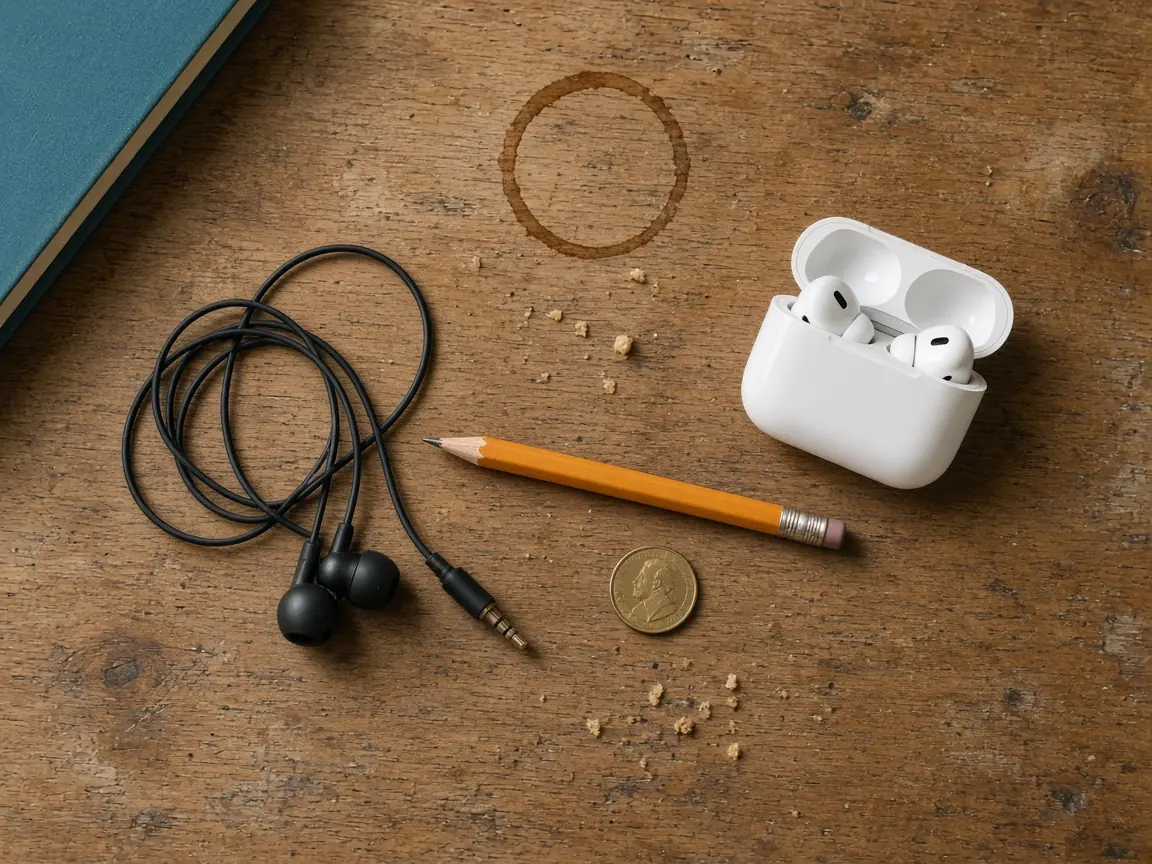
On a train last month I watched four people in a row untangle a cable, hunt for an adapter or open a small charging case with the same look of mild defeat. The wireless pair had run out of battery; the wired pair needed a dongle the phone no longer supported. Every option has some kind of tax.
Bluetooth earbuds are the default now, and for good reason. Nothing to snag on a coat or a door handle, and you can walk around the flat while on a call. The convenience is real. What it costs you shows up elsewhere.
What the numbers say
Bluetooth audio has to be compressed and sent over a radio link, and that causes a small delay. With the standard codecs on many phones, the delay is often somewhere around 100 to 200 milliseconds. For music you never notice it. For video, the player usually compensates. For games and some video editing, the lag is noticeable.
Wired headphones have effectively no delay, and no battery to run down. They also don't need pairing, so they work with a laptop, a plane's entertainment system and a ten-year-old music player without any setup.
| Factor | Wired | Bluetooth earbuds |
|---|---|---|
| Delay (latency) | None you can notice | Noticeable in games, fine for music |
| Battery | Not needed | A few hours per charge, plus the case |
| Price for decent sound | Low | Medium and up |
| Lifespan | Cable often fails first, cheap to replace | Batteries wear out and are hard to replace |
| Losing one | Rare | Common, replacements are expensive |
| Noise cancelling | Rare and bulkier | Widely available |
| Phone connection | May need an adapter | Just works |
Where wired still wins
For anyone gaming, editing audio, or playing a musical instrument through a phone or computer, wired is simply better. The lag makes timing feel off, and no amount of marketing about "low-latency mode" fully removes it.
The jack problem is real, though. Many phones no longer have a headphone socket, so a wired pair means a USB-C or Lightning version, or a small adapter. Cheap adapters vary a lot in sound quality and durability, and they tend to disappear into the bottom of a bag. If you go wired, buy a pair made for your phone's port instead of improvising.
For travel, I like having a cheap wired pair in the bag as a backup. Planes, gym equipment and some older gear still use a standard jack, and a spare pair that costs less than lunch is one of the best small purchases you can make.
For sound per euro, wired is also hard to beat. A decent pair can sound better than earbuds that cost several times as much, because none of the budget goes into the battery, chip or case.
Where Bluetooth wins
For commuting, exercise and chores, wireless is more comfortable. Noise cancelling on a noisy train or flight is a legitimate improvement, not a gimmick. Many people use it less for music and more to reduce the roar.
Calls are easier too. Hands-free, no cable to bump, and microphones in recent models are quite good.
A practical middle
If you buy wireless, treat it as a product with a lifespan of two or three years, because the batteries decline and are rarely replaceable. Don't pay for a premium pair if you often lose things.
Personally I'd keep both. A good wireless pair for the commute, a cheap wired pair in the drawer for everything else. It's not elegant, but it covers nearly every situation, and neither kind has to be perfect.