

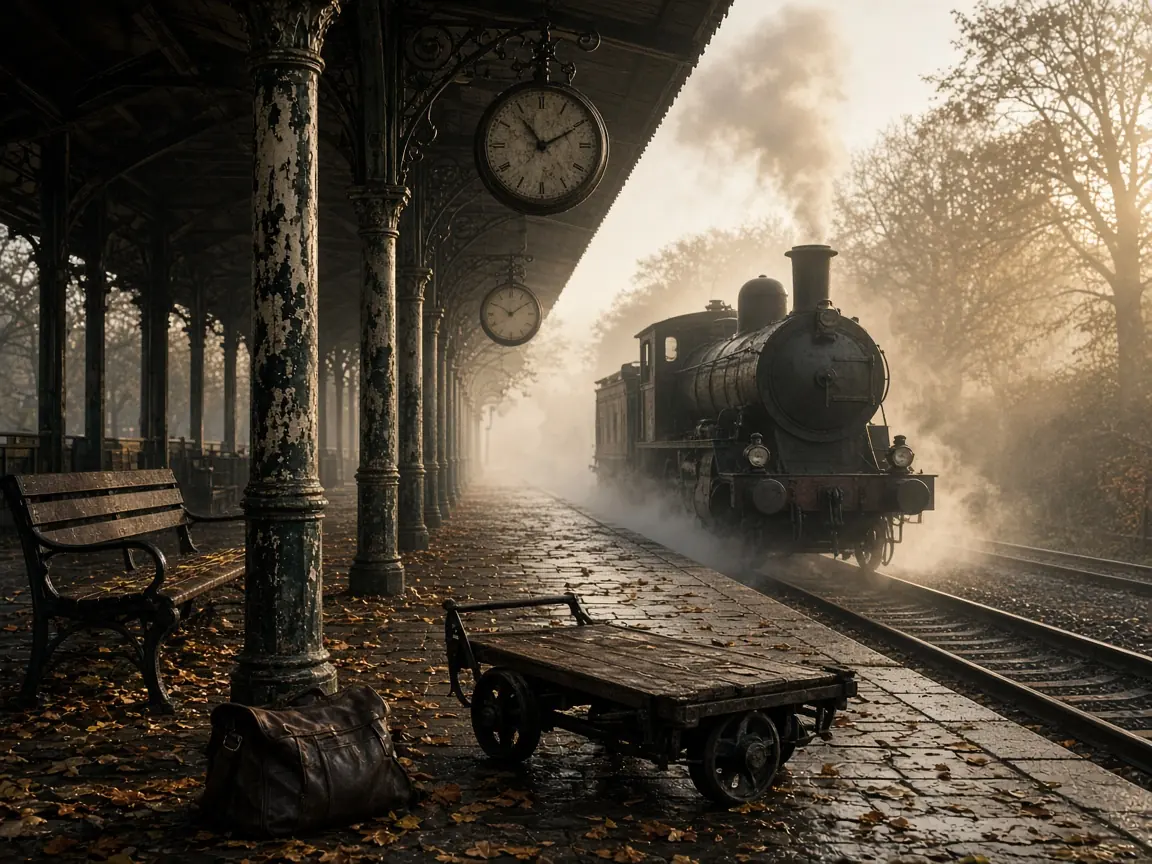
If you travelled west from London in the early 1800s, the clocks in the towns you passed were not in agreement. Bristol ran roughly ten minutes behind London, and places further west fell even further behind. Nobody cared much, because nobody could get from one to the other fast enough to notice.
That arrangement was perfectly reasonable. Local time is a natural thing: noon is when the sun is at its highest where you stand. Church clocks and town clocks were set by that rule, more or less, and a few minutes of difference between neighbouring towns was part of ordinary life.
Where it stopped working
Railways changed the arithmetic. A train moving at speed crossed several local times in a single trip, and a timetable that listed departures in each town's own time would have been unreadable. Imagine trying to catch a connection when each station's clock disagreed with the next.
Some companies simply picked a single time for operations. The Great Western Railway adopted London time along its whole line in 1840. Other British companies followed over the next several years, and by the late 1840s most were running on what we'd now call Greenwich Mean Time.
For a while, towns showed two clocks, or one clock with two minute hands, one for local time and one for railway time. Several surviving public clocks still show this. In Bristol, the Corn Exchange clock famously has a second minute hand.
Printed guides did their best. Railway timetables of the period often carried a little note or table saying how many minutes each town differed from London, so a traveller could convert in their head. It worked about as well as you'd expect, and missed trains because of it were a standard complaint.
Not everyone gave in quickly. Oxford sits a few minutes west of Greenwich, and the big bell at Christ Church still rings at five past nine in the evening, a small leftover of the local time the city once kept. It's the sort of detail that only makes sense once you know the story.
| Year | Event |
|---|---|
| 1840 | Great Western Railway adopts London time across its line |
| 1840s | Most British railways follow; the telegraph spreads time signals |
| 1880 | Greenwich Mean Time becomes the legal standard in Great Britain |
| 1883 | North American railroads introduce standard time zones on 18 November |
| 1884 | International conference in Washington picks Greenwich as the prime meridian |
| 1918 | US federal law officially establishes standard time zones |
Bigger country, bigger problem
North America had it worse. In the 1870s, railroads in the United States and Canada worked with dozens of different local times, with many separate ones in use by individual companies. A traveller crossing the continent could reset a watch many times.
The railroads solved it themselves. On 18 November 1883, they switched to a system of zones, usually one hour apart. People remember it as the "day of two noons", because in many places clocks were adjusted back, so noon happened twice. Some towns were happy to go along, others resisted for years. Law caught up much later, in 1918.
The telegraph quietly made all of it possible. Observatories could send time signals down a wire, and stations could synchronise to them. Without that, a shared time would have been much harder to enforce.
What got lost
Something was traded away here, and some people at the time said so. Local time was connected to the sun in a direct way. Standard time is connected to a convention. That's fine, and most of us wouldn't want to go back, but it's a reminder that our clocks are arrangements, not facts of nature.
It also explains why the lines on time-zone maps look so odd. They follow borders and railway routes and convenience as much as they follow longitude. Next time you look at one, you'll notice how many bends there are, and each of them is somebody's compromise.


